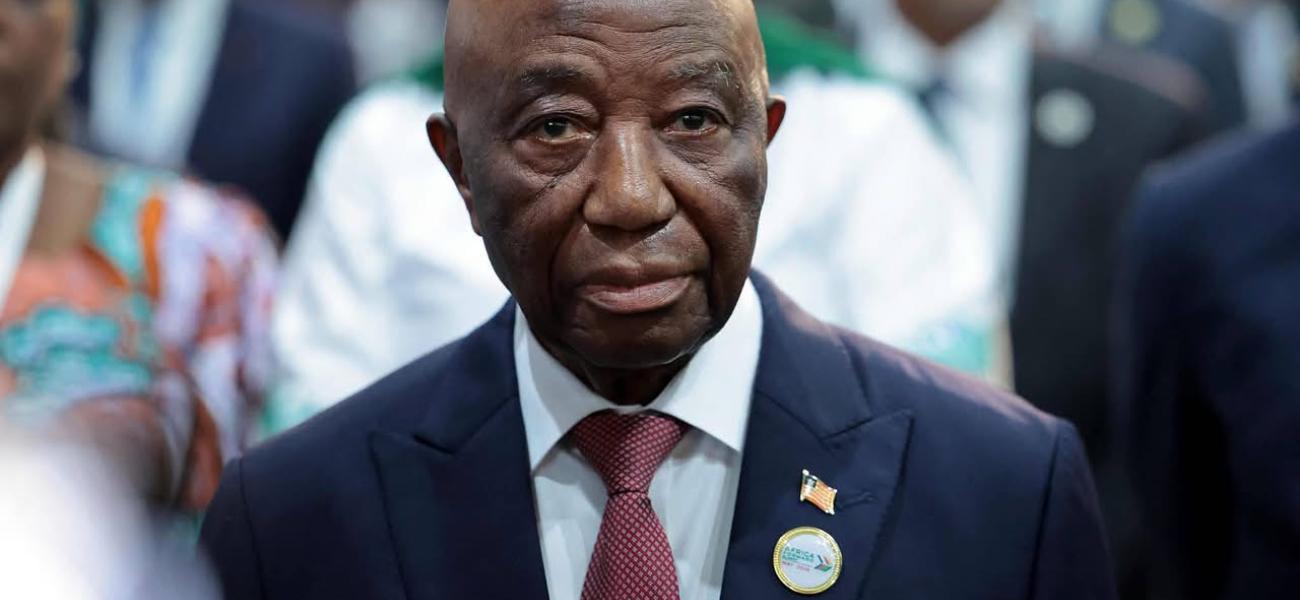
MONROVIA — Liberia’s national development agenda has recorded significant implementation activity since January 2025, but only a small fraction of the government’s commitments have been fully completed, according to the September 2026 President Meter Report released by Naymote Partners for Democratic Development.
The independent accountability report, which assesses implementation of President Joseph Nyuma Boakai’s ARREST Agenda for Inclusive Development (AAID), tracks 385 government interventions across six strategic pillars and 52 core programs between January 2025 and September 2026.
Naymote’s assessment places 225 of the 385 interventions, or 58.4 percent, in the completed or ongoing categories. However, the organization cautions that the 58.4 percent figure represents an “activation rate” rather than a completion or impact score.
Only 12 interventions, representing 3.1 percent, have been classified as completed, while 213 interventions, or 55.3 percent, remain ongoing. Another 57 interventions, or 14.8 percent, have not started, while 103 interventions, equivalent to 26.8 percent, could not be rated because sufficient evidence was unavailable.
Naymote says the figures show that the government’s development agenda has moved beyond its early activation phase, with implementation now visible across several sectors. At the same time, the report emphasizes that the central accountability question has shifted from whether projects have started to whether they will be completed on time, within budget, at acceptable quality and with measurable benefits for citizens.
Among the six pillars, Infrastructure Development recorded the highest activation rate at 67.3 percent, with 33 of its 49 interventions either completed or ongoing.
It was followed by Governance and Anti-Corruption at 63.7 percent; Environmental Sustainability at 63.3 percent; Rule of Law at 60 percent; Economic Transformation at 55.4 percent; and Human Capital Development at 53.1 percent.
The infrastructure pillar has produced some of the most visible outputs. Naymote reports 92.11 kilometers of primary roads paved or rehabilitated, 231.69 kilometers of secondary roads rehabilitated or maintained, 137 kilometers of urban and community roads upgraded, and 193.99 kilometers of feeder and village-access roads worked on.
The report also cites the procurement of 285 pieces of yellow machinery, expansion of National Transit Authority services with 53 buses and four trucks, production or distribution of 846 million gallons of water, and thousands of new household water and sewer connections.
Electricity access reportedly increased from 33 percent in 2024 to 37 percent in 2025, with about 40,000 new customers. Mount Coffee Hydropower Plant was restored to 88 megawatts, while a 20-megawatt solar facility was commissioned in June 2026.
Naymote also highlighted the groundbreaking of the US$363.9 million, 255-kilometer Western Corridor Road Project in April 2026.
Under Economic Transformation, Naymote reported several notable developments, including a decline in inflation from 12.8 percent in the first quarter of 2025 to 4 percent by December 2025.
Domestic revenue, meanwhile, rose from US$847.7 million in 2025 to more than US$1 billion by September 2026, according to government-reported figures cited by the report.
The assessment also points to more than 275,000 digital financial transactions and the procurement of 304 agricultural machines, alongside support for rice production, livestock, poultry, fisheries, farmer subsidies and mechanization hubs.
However, Naymote warns that increased revenue will only become meaningful for ordinary Liberians if it translates into improved public services, infrastructure, employment, productive investment and household welfare.
Governance and Decentralization Show Progress
The Governance and Anti-Corruption pillar recorded a 63.7 percent activation rate, with 35 of 58 interventions ongoing and two completed.
The report notes that at least 1,081 presidential appointees, representing 95 percent, had declared their assets, while 759,223 people were enrolled in the biometric identification system during the 2025 reporting period.
The Public Procurement and Concessions Commission also reported 56 procuring entities actively transacting on the electronic government procurement platform by June 2026, while the Internal Audit Agency expanded its coverage from 88 entities in 2024 to 95 in 2025.
Naymote further identified the formal launch of the Ministry of Local Government in April 2026 as an important step in Liberia’s decentralization process.
Human Capital Remains a Major Challenge
Human Capital Development, the largest AAID pillar with 130 interventions, recorded a 53.1 percent activation rate.
Although 69 interventions are ongoing, none had met Naymote’s evidence threshold for completion as of September 2026. Another 23 had not started, while 38 were not rated.
The report cites progress in education, teacher development, school feeding, digital learning, technical and vocational education, health, WASH and youth programs.
Among the reported outputs were 2,445 school operational permits issued or renewed, 1,463 PTA leaders trained, 692 teachers receiving professional development and 297 teachers trained in ICT.
Naymote, however, says the government must move beyond reporting numbers of trainings and other inputs to demonstrating improvements in learning, attendance, employment, health, nutrition and service quality.
Environmental Pillar Records No Completed Intervention
The Environmental Sustainability pillar recorded a 63.3 percent activation rate, with 19 of its 30 interventions ongoing.
However, none had been classified as completed, while four had not started and seven could not be rated.
Naymote points to progress in carbon-market governance, renewable energy and environmental regulation, including the presentation of Liberia’s consolidated National Carbon Market Policy to President Boakai on September 1, 2026.
The report stresses that transparent carbon accounting, land rights, community consent, public registries and equitable benefit-sharing will be critical if climate finance is to deliver inclusive benefits.
Accountability and Information Gaps Remain
Despite the progress recorded, Naymote identifies significant challenges in tracking and verifying implementation.
The organization says 103 interventions remain not rated, not necessarily because they have not been implemented, but because available evidence is insufficient to determine their status.
It cites inconsistent information-sharing by Ministries, Agencies and Commissions, limited publication of progress reports on official websites and inadequate access to supporting implementation records.
Naymote also warns that many AAID interventions are broadly defined without clear baselines, measurable targets, timelines, indicators or assigned responsibilities. It says there is no accessible consolidated public results framework linking all interventions to expected outputs, outcomes, indicators and targets.

To strengthen accountability through 2029, Naymote recommends that every AAID intervention be made specific, measurable, achievable, relevant and time-bound.
The organization is also calling on the Ministry of Finance and Development Planning to publish a consolidated results framework for all 385 interventions, establish one authoritative public tracking matrix, standardize reporting definitions, require quarterly evidence-based updates and link interventions directly to budgets, fund releases, expenditures and achieved results.
It further recommends the creation of a public AAID evidence portal containing project locations, budgets, procurement records, status updates, indicator data and completion evidence.
The Road Ahead
Naymote concludes that the AAID is no longer characterized by inactivity, but by a large portfolio of work in progress.
The organization says the ultimate test of President Boakai’s development agenda will be whether ongoing interventions are completed, delivered equitably across Liberia and translated into sustained improvements in the lives of citizens.
With only 12 of 385 interventions completed, Naymote’s latest assessment suggests that the government has made visible progress in launching and advancing programs, but faces a substantial task in turning implementation activity into completed projects and measurable development outcomes.