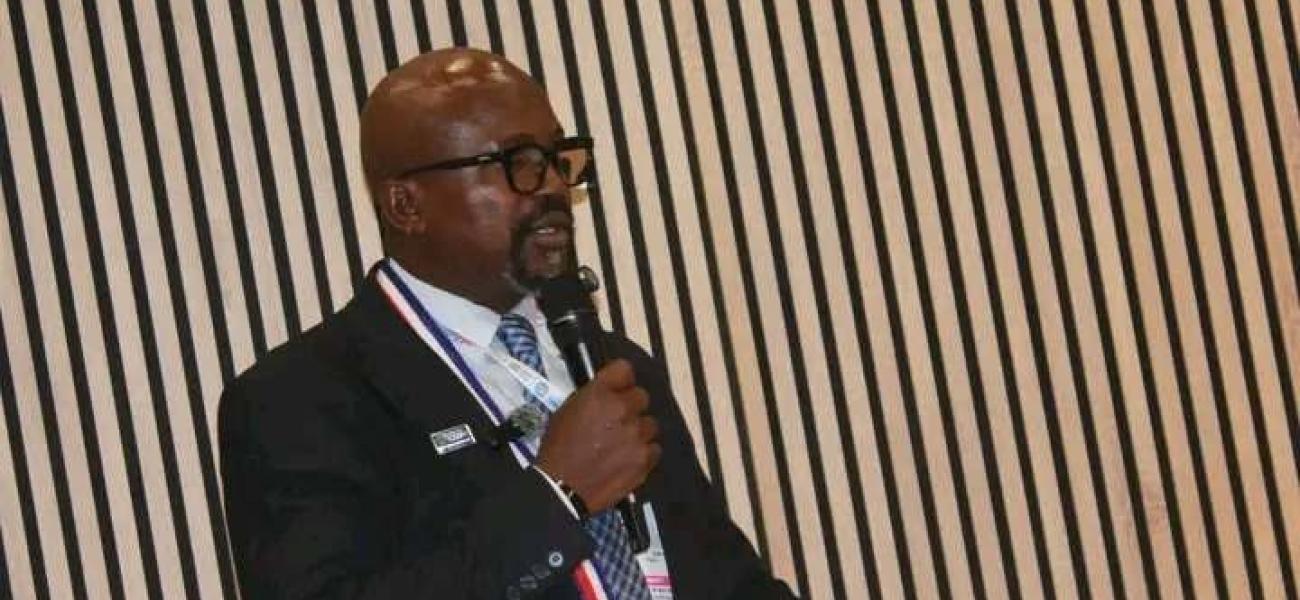
ANTALYA, Türkiye-Liberia's Minister of Public Works, Hon. Roland Layfette Giddings, has called for a complete redesign and rethinking of Liberia's public infrastructure to make it resilient to the growing and devastating impacts of climate change, particularly heavy rainfall, flooding, and extreme weather. Minister Giddings made the call on Tuesday, November 10, 2026, while speaking at a high-level side event organized by the Ministry of Public Works at the Liberia Pavilion during the ongoing 31st United Nations Climate Change Conference, COP31, in Antalya, Türkiye. The well-attended side event brought together senior Liberian government officials, representatives of civil society organizations, climate experts, and international development partners to discuss one of Liberia's most pressing development challenges on how to build infrastructure that can survive the climate crisis.
In his keynote address to that body, Minister Giddings laid out Liberia's climate paradox disclosing that Liberia receives nearly 5,000 millimeters of rainfall annually, making it one of the wettest countries in West Africa, stating that while this abundant rainfall is a blessing for agriculture, forests, and water resources, it has become a serious curse for the country's infrastructure."Our roads are washed away, our bridges collapse, our drainage systems are overwhelmed, and our communities are flooded year after year," the Minister noted.
He was frank in acknowledging that infrastructure designs of the past were flawed, noting that many of Liberia's roads, bridges, and drainage channels were designed decades ago without factoring in climate resilience, future rainfall projections, or flood mapping. The Public Work Minister said Liberia must now review existing approaches and adopt new engineering designs that can withstand the changing climate conditions taking place. He explained that the Ministry of Public Works under his leadership is now shifting focus from simply building roads to building resilient roads — roads with proper elevation, stronger pavement materials, climate-proof bridges, and most importantly, modern drainage systems capable of handling intense, prolonged downpours.
Major part of the Minister's presentation was dedicated to drainage, which he described as the weakest link in Liberia's infrastructure chain, stressing that without effective drainage, even the best-paved road will not last one rainy season. He called for a national priority on improving both primary and secondary drainage systems in greater Monrovia and other county capitals to effectively manage heavy rainfall, reduce urban flooding, and prevent the recurrent damage to roads, bridges, and private properties.
He further noted that although Liberia has so far been spared some of the catastrophic climate disasters seen in other parts of the world — such as massive landslides and cyclones — the country cannot afford to be complacent. With global temperatures rising and weather patterns becoming more unpredictable, Liberia must prepare now by investing in infrastructure that can withstand extreme weather conditions in the next 10, 20, and 50 years.
A key highlight of the Liberia Pavilion event was the unveiling of the Ministry of Public Works' innovative partnership with Conservation International; a partnership, formalized through a Memorandum of Understanding (MOU), seeks to promote a new and sustainable approach to infrastructure development in Liberia: the Green-Gray Infrastructure model, unlike the traditional "gray-only" approach that relies solely on concrete, steel, and conventional engineering, the green-gray approach combines nature-based solutions with conventional engineering. This includes using natural features like wetlands, mangroves, forests, and vegetated buffers to complement concrete drains, culverts, and embankments — thereby improving water absorption, reducing erosion, improving sustainability, and lowering long-term maintenance costs.
Through the collaboration, Conservation International is not only providing technical support but is also supporting intensive training programs for Liberian engineers. The training is designed to strengthen the capacity of engineers at the Ministry of Public Works to incorporate climate adaptation measures and nature-based solutions into every stage of infrastructure planning, design, and implementation.
Minister Giddings welcomed the partnership and described it as timely and forward-looking. He emphasized that Liberia's infrastructure future depends on three things which are continued collaboration, continuous innovation, and serious capacity-building for local engineers and technicians.
The session also underscored the urgent need for cooperation among all stakeholders with Participants agreeing that the Government alone cannot solve the climate-infrastructure challenge. There is a need for strong coordination among government institutions, civil society, private sector, and international development partners to identify practical, affordable, and locally appropriate solutions .Among the key actions highlighted at the end of the session were continued and expanded collaboration between the Ministry of Public Works and Conservation International; Ongoing training and retooling of Liberian engineers in climate-resilient design; A comprehensive review of existing national infrastructure standards and codes to integrate climate resilience; Prioritizing investments in modern drainage systems capable of managing the country's high annual rainfall.
Minister Giddings concluded by assuring Liberians and partners that the Government of Liberia, through the Ministry of Public Works, is committed to ensuring that future roads, bridges, and public buildings are not just built for today, but are built to withstand the climate realities of tomorrow.