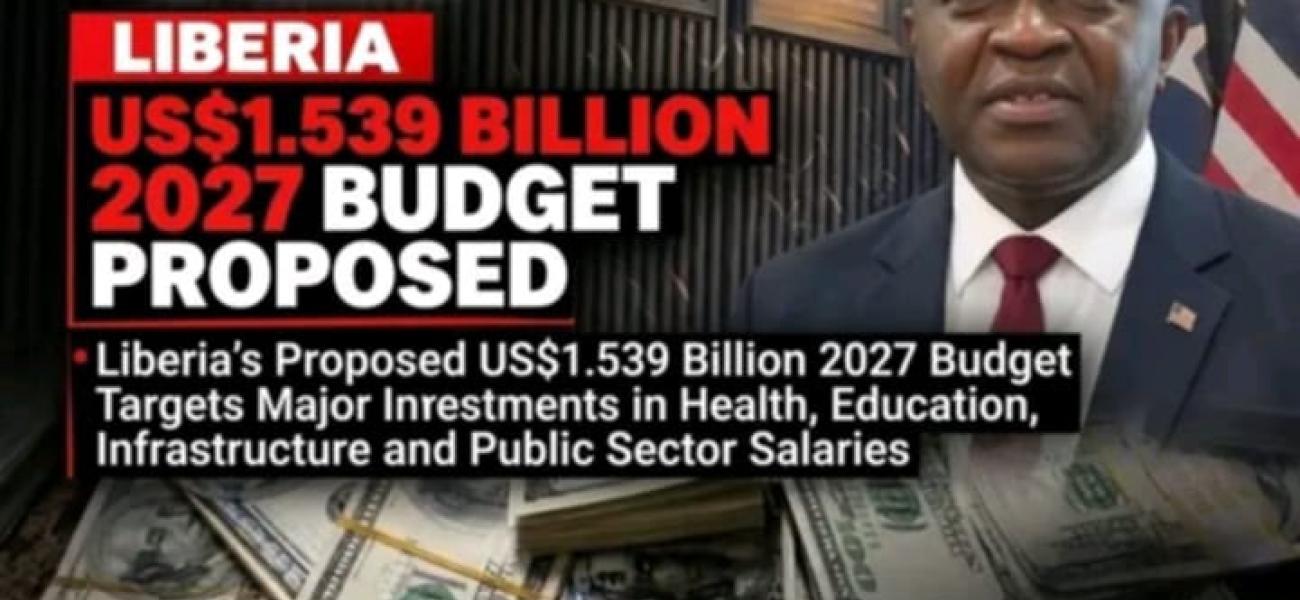
MONROVIA, Liberia — Finance and Development Planning Minister Augustine Kpehe Ngafuan has outlined major spending priorities under Liberia’s proposed US$1.539 billion National Budget for Fiscal Year 2027, highlighting increased investments in healthcare, education, infrastructure, public sector salaries, youth empowerment, and social protection.
Speaking at a special press briefing at the Ministry of Information on Monday, November 9, 2026, Minister Ngafuan described the proposed budget as the largest in Liberia’s history, representing an approximately 18 percent increase over the approved US$1.3 billion budget for 2026.
The proposed budget, submitted to the House of Representatives on November 6 on behalf of President Joseph Nyuma Boakai, is themed “A Growing Budget for Bigger Impact: Accelerating the Implementation of the ARREST Agenda for Inclusive Development.”
Ngafuan emphasized that the document remains a draft and is subject to legislative scrutiny, public hearings, and approval.
According to the Finance Minister, the proposed budget was developed through consultations with government spending entities, development partners, local stakeholders, civil society organizations, and citizens through the government's Open Budget Initiative.
He disclosed that spending entities submitted funding requests totaling approximately US$3 billion, significantly exceeding the resources available, thereby requiring government to make difficult choices among competing national priorities.
Domestic Revenue to Finance 94 Percent of Budget
The Finance Minister revealed that approximately US$1.447 billion, representing 94 percent of the proposed budget, is expected to come from domestic resources, including an estimated US$55 million carried forward from 2026.
The remaining US$92 million, representing six percent, is expected from external budget support.
Ngafuan also announced that Liberia collected more than US$1 billion in domestic revenue by September 2026, marking the first time in the country's history that domestic revenue collection surpassed that threshold within a single year.
He attributed the achievement to improved revenue administration, increased compliance, economic activity, and contributions from taxpayers.
Additionally, development partners are projected to provide approximately US$195.4 million in off-budget support for development programs.
However, the proposed revenue forecast includes US$40 million in contingent revenue, meaning corresponding expenditures will only be released if the funds are realized.
Health and Education Receive Increased Allocations
Healthcare and education are among the major beneficiaries of the proposed 2027 budget.
The health sector is expected to receive US$135.83 million, compared to US$110.9 million in 2026, representing an increase of approximately US$24.93 million or 22.5 percent.
The allocation includes funding for staffing, medical equipment, and the full operationalization of the New Redemption Hospital in 2027.
The government is also proposing US$5.3 million for improvements at the John F. Kennedy Medical Center, including support for new facilities, cancer treatment, dialysis services, and other critical medical equipment.
Other healthcare investments include US$1.3 million for upgrading the Jackson F. Doe Memorial Hospital, US$1.5 million for the ongoing renovation of C.H. Rennie Hospital, and US$800,000 to strengthen the country's response to Hepatitis B.
An additional US$1.23 million is proposed as initial funding for the construction of a National Children's Referral Hospital.
Meanwhile, education is expected to receive approximately US$163.55 million, representing an increase of about US$20 million over the 2026 allocation.
The proposed funding includes US$7 million for the continued renovation, furnishing, and equipping of the University of Liberia.
Other beneficiaries include the Monrovia Consolidated School System, Grand Kru Technical College, Booker Washington Institute, and Margibi University.
The budget also provides US$800,000 for the construction of a secure examination-printing facility for the West African Examinations Council (WAEC), alongside US$2.5 million for expanded school feeding and school health initiatives.
More Than 17,000 Public Servants Targeted for Salary Adjustments
In a major announcement, Ngafuan disclosed that the proposed 2027 budget includes compensation interventions expected to benefit more than 17,000 individuals through salary adjustments, recruitment, and the regularization of volunteers.
He said the government has been implementing a phased approach since 2025 to address salary disparities, improve working conditions, and bring additional workers onto the government payroll.
Among the proposed interventions are adjustments for qualified teachers in government schools, including institutions administered by the Ministry of Education and the Monrovia Consolidated School System.
The proposal also provides salary adjustments for 358 health workers across 146 health facilities and offices.
Additionally, 1,934 police officers are expected to benefit from upward salary adjustments as an initial step toward aligning compensation with their respective ranks.
The Liberia Drug Enforcement Agency is also expected to benefit from a proposed 15 percent salary increase for 616 officers.
Other proposed adjustments target some directors, deputy directors, and assistant directors within the civil service.
Ngafuan said the Civil Service Agency would subsequently provide further details regarding the salary adjustment arrangements.
On retirement security, he disclosed that the government has acknowledged nearly US$60 million in accumulated and unremitted employer contributions owed to the National Social Security and Welfare Corporation (NASSCORP).
The proposed approach provides for the statutory six percent employer contribution while progressively settling outstanding arrears through an amortization schedule.
US$142.56 Million Proposed for Infrastructure and Basic Services
Infrastructure development remains another major priority under the proposed budget.
The government has earmarked approximately US$142.56 million for Infrastructure and Basic Services, including US$49.1 million through the National Road Fund.
The allocation will support ongoing road projects and counterpart financing for major corridors, including Karloken to Fish Town, Sanniquellie to Loguatuo, and Fish Town to Kelipo.
The government is also proposing US$40 million to support electricity generation and distribution expansion, including efforts to strengthen the Liberia Electricity Corporation's capacity to reduce commercial losses through smart metering.
Additional investments will target rural renewable energy, water facilities, sanitation, and climate resilience.
The Agriculture sector is also expected to benefit from investments aimed at operationalizing mechanization hubs, strengthening agricultural value chains, and recruiting technical and extension personnel to improve agricultural productivity and farmers' incomes.
Youth Empowerment, Security Recruitment and Sports Funding
The proposed budget also outlines several initiatives targeting young people, including skills development, internships, entrepreneurship, and sports development.
Ngafuan disclosed that the government plans to continue recruiting 1,400 young Liberians into the country's security services, comprising 800 recruits for the Armed Forces of Liberia and 600 for the Liberia National Police.
The draft also includes US$2 million for motorcyclist empowerment initiatives, including the establishment of rest stops.
Additionally, US$3 million is proposed for the national football team, the Lone Star, while US$650,000 is earmarked to engage veteran Lone Star players in youth sports development.
Gender Ministry Allocation to Increase by 77 Percent
In an effort to strengthen social protection, the proposed allocation to the Ministry of Gender, Children and Social Protection is expected to increase by 77 percent.
The additional funding is intended to strengthen responses to sexual and gender-based violence, support safe homes, expand social protection services, and provide assistance to vulnerable populations.
The proposal also includes support for rural women's communal farming initiatives and women-led enterprises.
Meanwhile, tourism development is expected to receive increased attention, with the proposed allocation to the Liberia National Tourism Authority rising from US$4.07 million to US$7.72 million.
The funding will support tourism promotion and the development of key destinations, including Providence Island and Robertsport.
Debt Obligations Rise to US$275.5 Million
Despite the proposed budget increase, Ngafuan acknowledged that rising debt obligations will place additional pressure on government resources.
He disclosed that debt servicing and related obligations are projected to increase from approximately US$232 million in 2026 to US$275.5 million in 2027, representing an increase of US$43.5 million, or nearly 19 percent.
The obligations include payments to commercial banks, local businesses, and international creditors.
The proposed budget also includes approximately US$12 million for servicing Afreximbank financing secured in previous years for the Roberts International Airport road project, alongside payments to creditors such as the World Bank and African Development Bank.
Ngafuan stressed that honoring the country's financial commitments is necessary to maintain Liberia's credibility with development partners and creditors, while emphasizing the need for responsible borrowing and ensuring that financed projects deliver tangible results.
Increased Funding for Accountability Institutions
The government is also proposing increased allocations to institutions responsible for transparency and accountability.
Funding for these institutions is expected to rise from approximately US$37.9 million to US$49.13 million, including support for the General Auditing Commission and expanded anti-corruption services.
Additionally, six new county treasuries are expected to become operational in 2027, bringing the total number of facilities to ten, with the objective of improving financial administration and services across all 15 counties.
On tax reform, Ngafuan clarified that under the proposed Value Added Tax (VAT) framework, rice will remain exempt, while petroleum products will remain outside the VAT system but continue to attract other applicable taxes, fees, and levies.
Government Proposes New Procurement Measures
To improve public spending and procurement efficiency, the government is proposing several administrative changes.
Beginning January 2027, spending entities will be given the option to use 25 percent of their budgets allocated for vehicle purchases to acquire used vehicles, subject to standards and guidelines to be issued by the General Services Agency.
The government is also proposing to allow preliminary procurement activities before the beginning of a fiscal year, although binding contracts would remain contingent on the passage of the national budget.
Multi-year financial commitments would also require confirmation of funding availability from the Ministry of Finance and Development Planning.
Ngafuan said the measures are intended to improve planning, strengthen procurement processes, and ensure greater value for public resources.
Growth Projected at 5.1 Percent in 2027
Providing an overview of the country's economic outlook, the Finance Minister said Liberia's real economic growth is projected at 5.5 percent in 2026 and 5.1 percent in 2027.
He acknowledged that despite the positive economic projections, many Liberian households continue to face economic difficulties, while businesses require reliable electricity, accessible roads, and improved public services.
Approximately US$328.49 million, representing 21.3 percent of the proposed budget, has been allocated to the Public Sector Investment Program (PSIP), with priority given to ongoing projects and counterpart funding to advance investments toward completion.
Concluding his remarks, Ngafuan called on citizens, civil society organizations, businesses, and the media to closely examine the proposed budget and actively participate in the legislative review process.
He maintained that while the growth of the national budget represents progress, government must ensure that increased public resources translate into meaningful improvements in the lives of ordinary Liberians.
The proposed US$1.539 billion budget is now before the Legislature for review and approval.