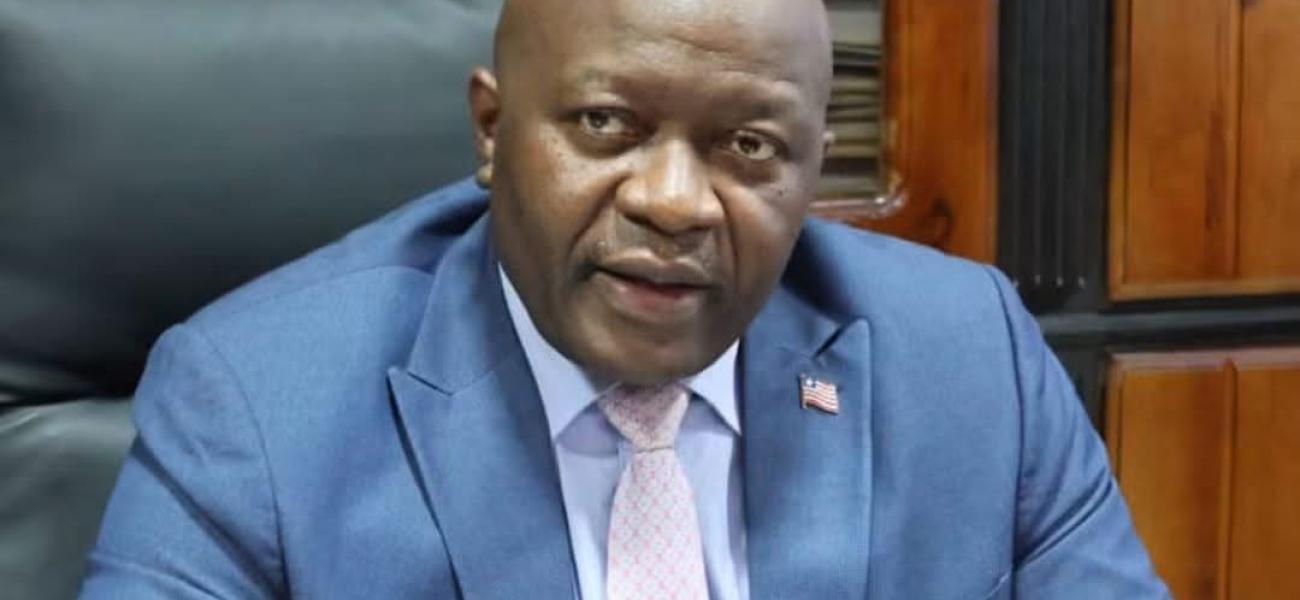
MONROVIA, Liberia-Finance and Development Planning Minister Augustine K. Ngafuan says Liberia continues to make progress toward macroeconomic stability and regional monetary convergence, with economic growth projected to reach 5.5 percent in 2026.
Minister Ngafuan made the statement Monday while delivering the opening remarks at the 56th Meeting of the Convergence Council of the West African Monetary Zone (WAMZ), held virtually under Liberia’s chairmanship.
Representing President Joseph Nyuma Boakai and the Government of Liberia, Minister Ngafuan welcomed finance ministers, central bank governors, regional institutions, development partners and other delegates to the meeting.
He said the gathering builds on recent technical and governors’ committee meetings that reviewed WAMZ macroeconomic developments, currency-crisis vulnerabilities, inflation-targeting frameworks, regional debt and capital market integration, and progress on the Pan-African Payment and Settlement System (PAPSS).
The discussions, he noted, remain aligned with the ECOWAS Monetary Cooperation Programme roadmap and the shared objective of launching the Eco single currency by 2027.
Minister Ngafuan highlighted improved economic performance across the WAMZ region despite global uncertainty, geopolitical tensions and rising energy and transportation costs.
According to figures cited in his remarks, regional economic growth increased from 4.2 percent in 2024 to 4.7 percent in 2025 and is projected to reach 5.3 percent in 2026.
He said compliance with the Zone’s primary convergence criteria improved from 41.7 percent in 2024 to 45.8 percent in 2025, while compliance with secondary criteria rose to 91.7 percent, bringing the overall convergence score to 61.1 percent.
Although no member state met all four primary criteria, the Finance Minister described the improvement as evidence of progress toward greater macroeconomic stability and policy harmonization.
Liberia’s Economy Projected to Grow 5.5 Percent
Providing an update on Liberia’s economy, Ngafuan said real Gross Domestic Product (GDP) growth increased from 4.0 percent in 2024 to an estimated 5.1 percent in 2025, with growth projected to accelerate to approximately 5.5 percent in 2026.
He attributed the performance largely to the primary sector, particularly mining and panning, with iron ore output expected to more than double in 2026.
The secondary sector is also projected to recover strongly, moving from a 2.8 percent contraction to 5.9 percent growth, supported by increased cement and beverage production.
The tertiary sector, meanwhile, is expected to grow by 3.7 percent, supported by increased electricity supply and construction activities.
Inflation Falls Sharply
Minister Ngafuan also pointed to significant progress in containing inflation.
He said end-period inflation declined from 10.7 percent in December 2024 to 4.0 percent in December 2025 as a result of what he described as disciplined monetary and fiscal coordination.
However, inflation increased to 5.0 percent by June 2026, partly due to higher imported fuel costs. Despite this increase, average inflation during the first half of 2026 stood at 4.5 percent, substantially below the 12.2 percent recorded during the same period in 2025.
Ngafuan said average inflation remains Liberia’s only outstanding primary WAMZ convergence criterion and expressed confidence that the country would close the gap by the end of 2026.
Revenue Rises, Public Debt Declines
The Finance Minister reported that Liberia’s total revenue and grants increased by 18.6 percent to US$887.6 million in 2025, compared with US$748.2 million in 2024.
Tax revenue reportedly increased by 23.7 percent, which Ngafuan described as part of the country’s strongest domestic revenue performance in history.
He said the improved fiscal position, supported by digitalization and stronger compliance, helped reduce Liberia’s public debt-to-GDP ratio from 56.4 percent in 2024 to 54.9 percent in 2025.
He also highlighted the Legislature’s approval of Liberia’s US$1.3 billion national budget for Fiscal Year 2026, the largest in the country’s history, saying it would help finance the Government’s ARREST Agenda for Inclusive Development.
Government Advances Infrastructure and Energy Projects
Ngafuan said the government is accelerating construction and rehabilitation along several strategic road corridors, including the Monrovia-Freetown highway, the Southeastern corridor and the Bong-to-Lofa road.
He said the projects are expected to reduce transportation and logistics costs, improve domestic and cross-border trade, and strengthen Liberia’s regional economic integration.
On energy, the Minister said the government is expanding hydropower generation while extending the national electricity grid to increase access in Grand Bassa County and southeastern Liberia.
He also highlighted reforms in taxation, including Liberia’s transition toward a full Value Added Tax regime, with the VAT rollout scheduled for January 2027.
Liberia Meets Three of Four Primary WAMZ Criteria
According to Ngafuan, Liberia met three of the four primary WAMZ convergence criteria in 2025—the fiscal deficit, central bank financing of the budget deficit and external reserves.
He said Liberia’s external reserves position was recently revised upward to 3.2 months of import cover following an IMF mission.
The country also met both secondary convergence criteria for the second consecutive year, maintaining public debt below the 70 percent regional ceiling and keeping exchange-rate variation against the WAUA within the prescribed ±10 percent band.
Ngafuan said the government remains committed to addressing inflation, the country’s remaining primary convergence gap.
Liberia Reaffirms Commitment to 2027 Eco Target
Looking ahead, the Finance Minister said Liberia’s medium-term economic outlook remains favorable, with growth expected to remain between approximately 5.1 and 5.5 percent through 2026.
He said inflation is projected to decline from 8.5 percent in 2025 to 6.3 percent in 2026 and 5.3 percent in 2027.
However, he identified domestic structural challenges, the effects of the 2025 suspension of USAID-supported programs, and global trade and geopolitical tensions as key risks to the outlook.
As WAMZ countries work toward the 2027 Eco target, Ngafuan urged member states to sustain monetary, fiscal and structural reforms necessary to achieve full convergence.
He concluded by reaffirming Liberia’s commitment to the WAMZ Work Programs and the ECOWAS Single Currency Program, while commending regional institutions and development partners for their continued support to West Africa’s monetary integration agenda.