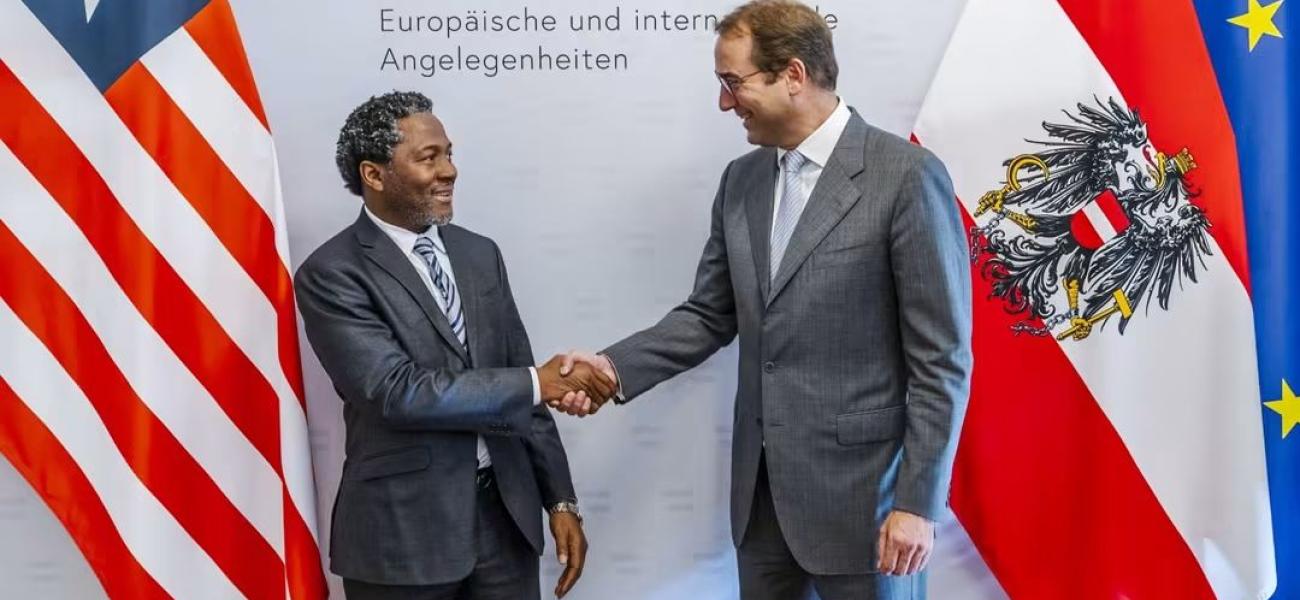
VIENNA, Austria-Liberia and Austria are moving to strengthen bilateral relations, with both countries identifying peace and security, trade and investment, vocational education, diplomatic training and private-sector development as key areas for expanded cooperation.
The commitment was reached during a bilateral meeting between Liberia’s Deputy Minister for International Cooperation and Economic Integration, Dr. Ibrahim Nyei, and Austria’s Secretary-General for Foreign Affairs, Ambassador Nikolaus Marschik, at Austria’s Federal Ministry for European and International Affairs in Vienna.
The meeting comes as Liberia and Austria prepare to serve consecutively on the United Nations Security Council, creating an opportunity for closer coordination on international peace and security issues.
Liberia is currently serving a two-year term on the Council from 2026 to 2027, while Austria was elected in June to serve from 2027 to 2028.
During the meeting, Deputy Minister Nyei called for enhanced coordination between the two countries on issues before the Security Council, particularly matters relating to peace and security in West Africa and the Sahel.
He emphasized the importance of the United Nations Office for West Africa and the Sahel (UNOWAS) as an important framework for promoting regional stability and strengthening cooperation between the Economic Community of West African States (ECOWAS) and countries in the Sahel.
The discussions also explored opportunities to expand economic relations and encourage greater participation by Austrian businesses in Liberia.
Dr. Nyei highlighted Liberia’s interest in attracting Austrian companies, investment and technical expertise in sectors including energy, digital solutions, vocational education, hospitality and other areas with potential to create employment opportunities for young Liberians.
The officials also discussed Austria’s Africa Strategy 2026–2029, which provides a framework for deeper Austrian engagement with African countries in areas such as security, economic cooperation, education and climate action.
The Austrian side expressed readiness to share its experience with the country’s dual apprenticeship model, which combines classroom instruction with practical training within companies.
Both sides discussed the possibility of exchanges and study visits to examine how elements of the Austrian model could contribute to strengthening Liberia’s technical and vocational education programs.
The meeting further considered possible Austrian support for hospitality and service-sector training, particularly as Liberia seeks to expand skills development and employment opportunities for its youthful population.
Deputy Minister Nyei also proposed a formal partnership between Liberia’s Foreign Service Institute and the Diplomatic Academy of Vienna.
The proposed partnership would provide opportunities for the two institutions to exchange expertise and explore joint diplomatic training programs, including initiatives that could increase opportunities for Liberian diplomats to receive training in Liberia.
The Austrian side expressed openness to connecting the two institutions and continuing diplomatic training opportunities, including programs aimed at supporting female diplomats from West Africa.
The two sides also discussed the possibility of establishing an Austrian honorary consular presence in Monrovia, alongside measures to strengthen engagement between Austrian businesses and the Liberian private sector.
Both countries reaffirmed their interest in maintaining closer diplomatic engagement and identifying practical areas of cooperation capable of further strengthening Liberia-Austria relations.
Dr. Nyei was accompanied by Liberia’s Ambassador to Germany, with co-accreditation to Austria, H.E. Ambassador Youngor S. Telewoda; Assistant Minister for International Organizations at the Ministry of Foreign Affairs, Daniel Kokoi; and Augustine Hamelberg, Minister Counsellor for Public Affairs at the Embassy of Liberia in Germany, with co-accreditation to Austria.