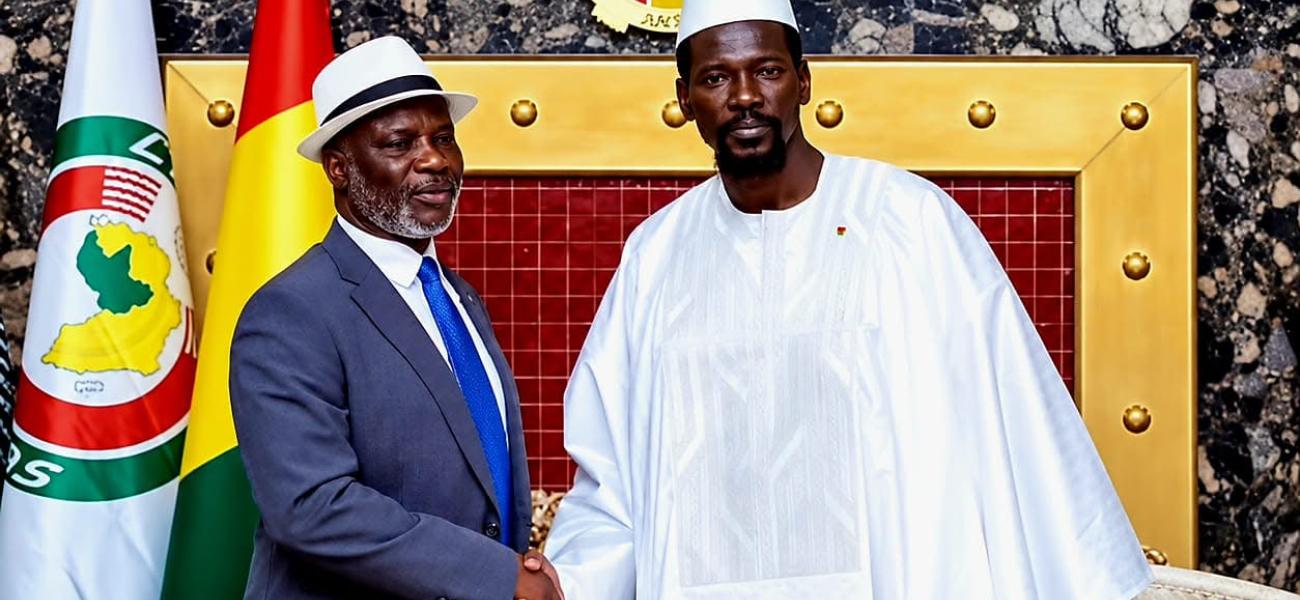
CONAKRY, Guinea – When Liberia's House Speaker Richard Nagbe Koon sat down with Guinean President Mamadi Doumbouya in Conakry this week, the optics were familiar — smiles, handshakes, and statements about brotherhood.
But beneath the ceremony lies a more strategic agenda that could reshape cooperation across the Mano River Union.
Speaker Koon was in Guinea for the opening of the country's 10th legislature, a gathering that drew parliamentary leaders from across West Africa. While the event itself was ceremonial, Koon used the platform to push three issues: regional integration, border management, and the long-delayed Mano River Union Parliament.
Liberia and Guinea share more than a 500-kilometer border. Market women cross daily to trade, families live on both sides, and security incidents on one side quickly spill over to the other.
The same is true for Sierra Leone and Côte d'Ivoire — the other two members of the Mano River Union (MRU).
For decades, governments have tried to manage shared challenges — smuggling, irregular migration, armed groups, poor roads, and border harassment — largely through executive diplomacy. Presidents meet, sign communiqués, and return home.
Koon's message in Conakry was different. He argued that the region's borders should be turned into "properly managed and secure bridges" instead of barriers — a line that captured the frustration of traders and border communities who face extortion and delays despite ECOWAS protocols on free movement.
That framing shifts the discussion from diplomacy to institution-building.
Traditionally, foreign policy is run by presidents and foreign ministers. But every agreement on trade, security, or infrastructure must eventually be funded, ratified, and harmonized into national law by parliaments.
Koon stressed that point in Conakry: "Executives negotiate, but parliaments translate agreements into laws, budgets and institutions."
Without legislative backing, regional agreements remain paper promises. If MRU lawmakers coordinate on customs procedures, migration laws, and security oversight, cross-border agreements are more likely to actually work.
The biggest takeaway from the visit is not the Koon–Doumbouya meeting itself, but what it points to — the push to operationalize a Mano River Union Parliament.
The idea is no longer abstract. In July 2025, parliamentary leaders from Liberia, Guinea, Sierra Leone and Côte d'Ivoire endorsed the creation of an MRU Parliament in the Monrovia Declaration.
The problem has been implementation.
Koon used his Conakry visit to press for action beyond declarations. He argued a regional parliamentary body could help harmonize trade laws, coordinate border security oversight, and provide a legislative backbone for peacebuilding.
He also announced that Monrovia will host a follow-up parliamentary summit from December 9–11, 2026, focused on boosting intra-African trade and investment through legislative cooperation.
That December meeting will be the real test of whether the current momentum is genuine.
If MRU cooperation improves, it could mean less harassment at border posts in Ganta, Koindu, and Nzérékoré; faster movement of goods; joint infrastructure like roads and bridges; and better coordination against drug trafficking and cross-border crime.
For governments, it also matters. Instability in one MRU country has historically affected all four — from civil wars to Ebola. A stronger regional parliamentary platform would give lawmakers a direct stake in regional stability.
Ultimately, the handshake between Koon and Doumbouya will be judged not by the statement that followed, but by what happens next.
Will the MRU Parliament move from declaration to a functioning institution? Will the December Monrovia meeting produce harmonized bills? Will border communities feel a difference?
For a region where people have been integrating themselves for centuries through trade, marriage, and culture, the task for politicians is to catch up — and build institutions that reflect that reality.