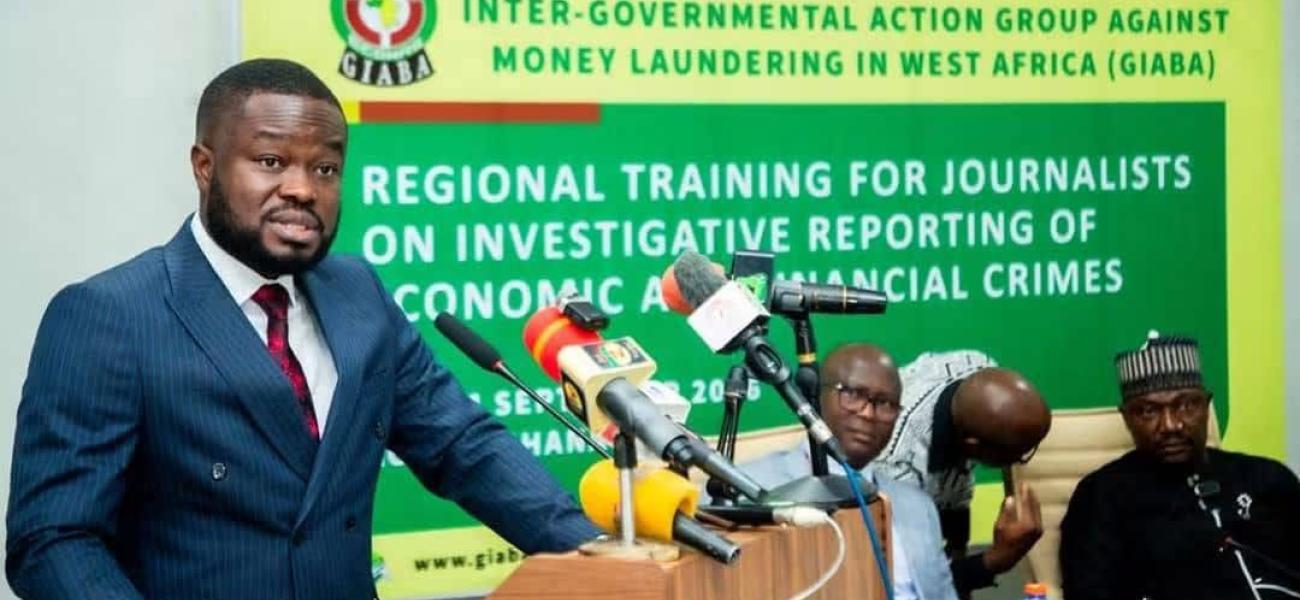
ACCRA, Ghana -The Inter-Governmental Action Group Against Money Laundering in West Africa (GIABA) has opened a three-day regional training workshop in Accra aimed at sharpening the investigative skills of journalists covering economic and financial crimes.
The workshop, which kicked off Tuesday, has drawn journalists from 15 West African countries — Liberia, Niger, Cabo Verde, Côte d'Ivoire, Ghana, Guinea, Guinea-Bissau, Burkina Faso, Nigeria, Sierra Leone, Togo, Benin, The Gambia, Mali and Senegal — and forms part of GIABA's ongoing push to build stronger media capacity around reporting on money laundering, terrorist financing and related offences.
Speaking on behalf of GIABA's Director General, Mam Cherno Jallow, the agency's Principal Officer for Communication and Advocacy, Timothy Melaye, said West Africa remains exposed to shifting threats from money laundering, terrorist financing and proliferation financing. He pointed to high-level corruption, illicit flows from the extractive sector, terrorism financing, misuse of virtual assets, drug trafficking and weak oversight of non-financial businesses as key vulnerabilities facing the region.
"The fight against money laundering and terrorist financing cannot be fully effective without the active involvement of media, and particularly of you, the investigative journalists, who are our strategic allies," Melaye told participants, adding that journalists have a unique capacity to uncover wrongdoing, inform the public and push decision-makers toward greater accountability.
He noted that GIABA's collaboration with the media stretches back to 2009 and sits alongside its work with law enforcement, judges, prosecutors, regulators, financial institutions and civil society groups. He also touched on the agency's efforts around beneficial ownership disclosure and its partnerships with bodies such as the FATF, the European Union, GIZ and the African Development Bank.
Benjamin Ofori, Director of Legal at Ghana's Financial Intelligence Centre, speaking on behalf of FIC Director General Albert Kwadwo Twum Boafo, said tackling financial crime demands cooperation across sectors — from financial intelligence units and regulators to the judiciary, private sector and media.
He warned that criminals are increasingly exploiting technology, digital finance, complex corporate structures and cross-border transactions to hide illicit proceeds, making the journalist's job harder but more essential. For reporters, he said, that means learning to "follow the money" — tracing corporate structures, identifying beneficial owners, cross-checking financial and procurement records, and using open-source tools to connect the dots.
"Look for the story behind the transaction, the person behind the company, the ownership behind the asset and the financial trail behind the crime. Above all, follow the evidence," Ofori told the journalists.
He also cautioned that digging up information is only half the job — verification, context, source protection and adherence to due process matter just as much, stressing that the goal isn't simply more stories on financial crime, but journalism that helps the public genuinely understand how these crimes work and what can be done about them. Melaye echoed similar concerns, noting that poor due diligence and misinformation still crop up in some AML/CFT coverage, and urged participants to use the training to raise their standards.
Both officials stressed that financial crime rarely respects national borders — illicit funds move quickly between jurisdictions, often exploiting gaps between different countries' regulatory systems. That, they said, is precisely why regional cooperation between GIABA and the media matters: equipping journalists to expose financial networks and explain complex transactions can help bring corruption and illicit finance into public view.
Beyond sharpening individual reporting skills, the Accra workshop is meant to deepen ties between GIABA and the region's press corps and grow a network of journalists committed to transparency