Liberia is moving to confront one of the financial sector’s most persistent challenges with the establishment of a National Non-Performing Loans Task Force, an initiative President Joseph Nyuma Boakai’s administration says will drive coordinated action to address bad loans and strengthen the country’s financial system.
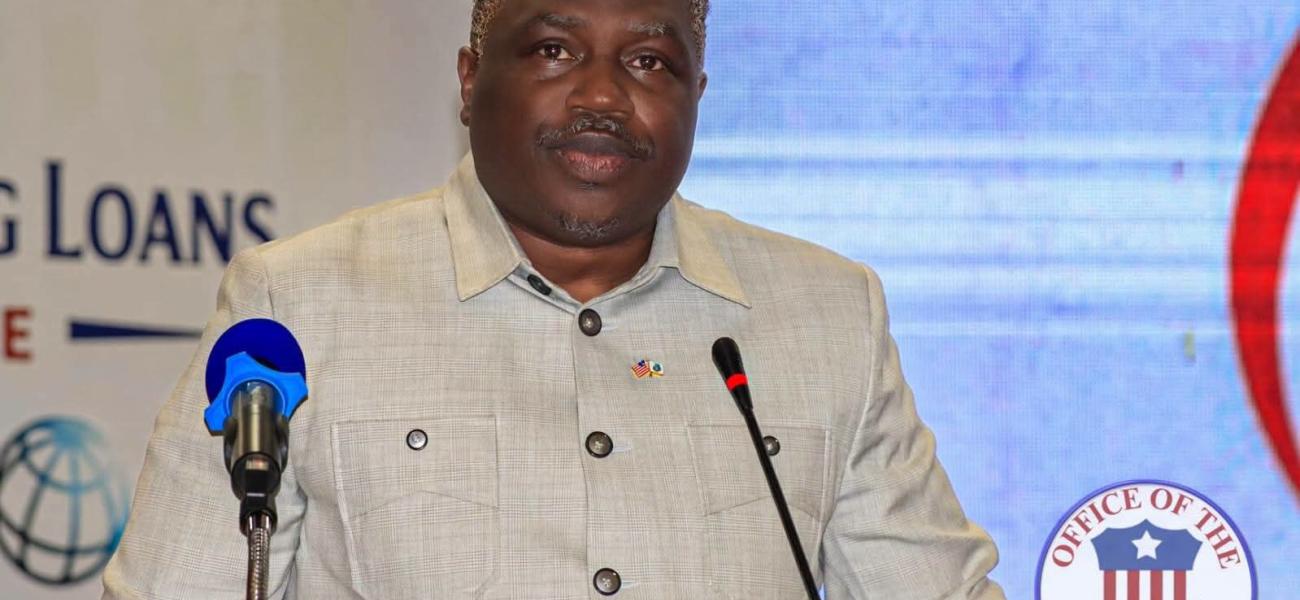
Vice President Jeremiah Kpan Koung, Sr. announced the initiative Friday while delivering the closing remarks at the National Conference on the Resolution of Non-Performing Loans in the Liberian Financial Sector in Monrovia.
The move signals a shift from discussion to implementation as government seeks to tackle the structural challenges that have constrained lending, increased the cost of credit and limited the ability of businesses and entrepreneurs to access financing.
A NATIONAL RESPONSE TO A NATIONAL PROBLEM
Vice President Koung said the Task Force, being established on President Boakai’s directive, will bring together the Central Bank of Liberia, Ministry of Finance and Development Planning, Ministry of Justice, financial institutions, relevant government agencies, development partners, technical experts and other key stakeholders. Its mandate will be to create a coordinated national framework for resolving non-performing loans while strengthening the resilience of Liberia’s financial sector.
The initiative is also intended to promote responsible lending, expand credit growth and restore confidence in Liberia’s banking system.
President Boakai has directed the relevant institutions to move expeditiously to finalize the Task Force’s composition, terms of reference and implementation action plan. The plan, Vice President Koung said, must establish clear responsibilities and timelines while putting in place mechanisms to monitor and report progress.
FROM CONFERENCE ROOM TO CONCRETE ACTION
For the Boakai administration, the challenge now is implementation.
Vice President Koung said the President expects the Task Force to move beyond recommendations and discussions toward tangible action—particularly in resolving legacy non-performing loans and strengthening systems capable of preventing new bad loans from accumulating. He described the Task Force as an important step toward transforming the outcomes of the national conference into measurable financial-sector reforms capable of supporting private-sector development.
The Vice President emphasized that non-performing loans are not simply a problem confined to commercial banks. Their impact extends throughout the wider Liberian economy. “Resolving non-performing loans is not simply about improving commercial bank balance sheets; it is about unlocking economic opportunity, expanding access to finance, encouraging investment, supporting entrepreneurship, and creating jobs for the Liberian people.”
High levels of non-performing loans, he explained, restrict lending, limit private-sector expansion, increase the cost of credit and ultimately weaken economic growth.
THE STRUCTURAL BARRIERS
The conference identified several factors contributing to Liberia’s non-performing loan challenge. Among them are weaknesses in credit infrastructure, legal and judicial bottlenecks, governance challenges, gaps in enforcement mechanisms and broader economic conditions. Yet Vice President Koung struck an optimistic tone, insisting that Liberia possesses the expertise, institutional capacity and national determination necessary to confront the problem.
“The policy options have been identified. The reform priorities have been articulated. The responsibilities of stakeholders have been clarified. What remains is implementation,” he emphasized.
FINANCE AS A DRIVER OF NATIONAL DEVELOPMENT
The Vice President linked financial-sector reform directly to the administration’s broader development agenda. He said a strong and resilient financial system is essential to achieving the objectives of the ARREST Agenda for Inclusive Development, stressing that Liberia’s economic transformation cannot be sustained without an efficient financial system capable of delivering affordable and sustainable financing to businesses and individuals. Particular attention, he said, must be given to micro, small and medium-sized enterprises, women-owned businesses, young entrepreneurs, agricultural value chains and underserved communities.
The government, he added, supports measures designed to strengthen prudential supervision, credit-risk management and Liberia’s credit infrastructure, alongside reforms in debt recovery, insolvency administration, collateral enforcement and commercial dispute resolution.
EVERY STAKEHOLDER HAS A ROLE
Vice President Koung made clear that solving Liberia’s non-performing loan problem will require collective responsibility. Government agencies must strengthen policies and coordination. The Legislature must support necessary legal reforms, while the Judiciary must help reinforce contract enforcement and commercial justice. Financial institutions must improve governance, underwriting standards and risk-management practices. Borrowers, meanwhile, must honor their obligations and contribute to a stronger culture of repayment and accountability. Development partners are also expected to contribute technical expertise and financial support.
The message was clear: financial-sector reform cannot be delivered by government alone.
THE TEST IS IMPLEMENTATION
Vice President Koung urged stakeholders not to allow the commitments made at the conference to remain on paper. The ultimate measure of success, he said, will be whether reforms are implemented, whether more credit reaches productive sectors, whether businesses are able to grow, whether jobs are created and whether confidence returns to Liberia’s financial system. Then came perhaps the most defining message of the conference: “History will not judge this conference by the quality of the presentations delivered in this hall. History will judge it by the reforms implemented after we leave.”
A COMMITMENT TO REFORM
Vice President Koung reaffirmed the government’s commitment to working with the Central Bank of Liberia, Legislature, Judiciary, financial institutions, development partners and the private sector to ensure that the momentum generated by the conference continues beyond the closing ceremony.
“Our commitment is to implementation of the outcome, the recommendations and the commitments from all stakeholders. Our commitment is to reform. And our commitment is to delivering tangible benefits for the Liberian people,” he said.
He called on stakeholders to move forward with determination, emphasizing that Liberia must choose action over aspiration.
“Together, let us unlock access to finance, strengthen financial stability, expand economic opportunity, and build a more prosperous Liberia for generations to come,” Vice President Koung declared.
The Vice President concluded by thanking the Central Bank of Liberia, the Ministries of Finance and Development Planning and Commerce and Industry, development partners, panelists, technical experts and participants for their contributions. He also conveyed greetings from President Joseph Nyuma Boakai and reaffirmed the administration’s commitment to building a stronger, more resilient and inclusive Liberian economy.
HARDFACTS EDITORIAL TAKE
The announcement of the National Non-Performing Loans Task Force represents a critical test of Liberia’s ability to convert policy discussions into measurable economic action.
The challenge is no longer simply identifying the problem. The priorities have been articulated, the stakeholders identified and the need for reform acknowledged.
Now comes the harder part: implementation.
For Liberian businesses, entrepreneurs and households seeking access to affordable credit, the success of this initiative will ultimately be judged not by the conference, but by what happens afterward.