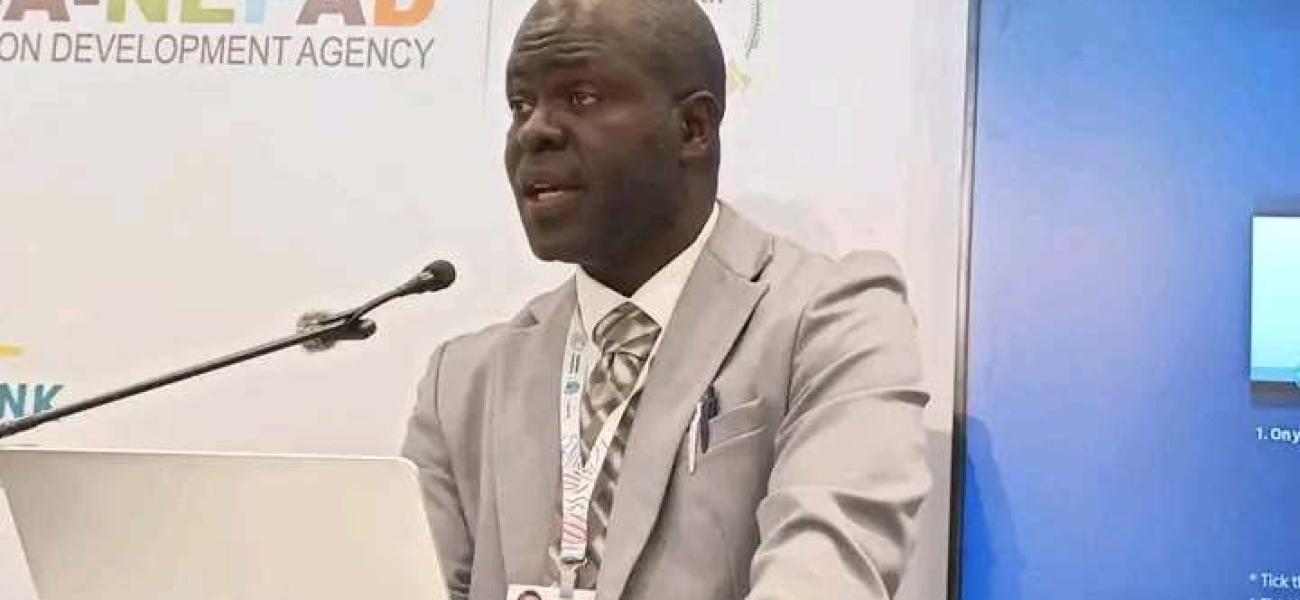
ANTALYA, Türkiye-Carbon finance can become a powerful tool to strengthen African agriculture against the devastating impacts of climate change, but only if African farmers are at the center of it and protected by clear, fair rules, the Executive Director of Liberia's Environmental Protection Agency, Dr. Emmanuel K. Urey Yarkpawolo, has said.
Dr. Yarkpawolo made the statement on Tuesday at a high-level side event titled “Carbon Finance for Resilient African Agriculture,” held at the African Pavilion during the 31st United Nations Climate Change Conference, COP31, in Antalya, Türkiye. The event, co-hosted by the African Union Development Agency-NEPAD (AUDA-NEPAD) and the Voluntary Carbon Markets Integrity Initiative (VCMI), brought together a diverse group of stakeholders, including representatives of African Union institutions, government ministers, development partners, farmers' organizations, private carbon-market actors, and climate experts, to discuss how investment from carbon markets could be channeled to support climate-resilient agriculture across the continent.
Delivering a strong and farmer-focused message, Dr. Yarkpawolo cautioned against rushing into carbon markets without addressing the fundamentals of African farming.“Before we speak about carbon credits, we must speak about food security, healthy soils, secure land rights, and household incomes,” he told the gathering. According to him, the debate on carbon credits in Africa has often been dominated by technical jargon, emission numbers, and international market prices, while forgetting the people who actually work the land. He stressed that for Liberia, and for Africa at large, the value of carbon finance should not be judged by how many credits are sold on the international market, but by what it delivers to the smallholder farmer in Bong County, Lofa, Nimba, or Grand Gedeh.
He pointed out that if properly designed, carbon finance has huge potential to restore depleted and degraded farmland, support improved and climate-smart farming practices, provide additional income for struggling farm families, and protect farms for future generations.
Dr. Yarkpawolo used the occasion to outline Liberia's progressive approach to carbon markets. He disclosed that Liberia's newly developed National Carbon Market Policy does not focus only on forestry, where most attention has been, but deliberately includes agriculture alongside forestry and other sectors.Crucially, the policy contains strong social safeguards. It fully recognizes community and private land rights, in line with Liberia's Land Rights Act, and requires Free, Prior and Informed Consent (FPIC) for any carbon project that will affect community resources. It also provides for a mandatory benefit-sharing mechanism to ensure that communities and farmers receive a fair share of revenues generated from their land and labor.To ensure credibility, the EPA, as Liberia's national carbon market regulator, is responsible for leading the country's national system for Measuring, Reporting and Verifying (MRV) emissions reductions. This, he said, will help ensure that carbon credits issued from Liberia reflect real, credible, and verifiable climate benefits, not hot air, and can compete in high-integrity international markets.
The EPA boss outlined potential agricultural activities that Liberia is considering under its carbon market framework. These include agroforestry — integrating trees with crops — restoring degraded farmland, improving soil health and soil carbon management, and exploring lower-emission rice production systems to cut methane emissions from swamp rice farming.However, he stressed that no project should be imposed. Every project must be carefully assessed and designed to suit local farming conditions, cultural practices, and the needs of the community.
Dr. Yarkpawolo laid out three clear priorities that should guide future cooperation on agricultural carbon finance in Africa. First, enabling farmers to participate. He said smallholders need strong extension services, accessible information in local languages, and support through cooperatives, so that the high costs and technical requirements of carbon projects do not shut them out from the start. Second, financing the transition upfront. Farmers should not be expected to bear the costs of changing their farming practices and then wait for three to five years for uncertain carbon payments. He called for patient investment, upfront financing, and credible buyers who are willing to commit long-term. Third, making fairness measurable and enforceable. Contracts must be simple and understandable, land rights must be legally protected, and payments must be transparent and traceable. He specifically emphasized that women and young people, who provide the bulk of agricultural labor in Liberia and Africa, must have a meaningful voice and guaranteed share in project decision-making and benefit-sharing.
The Antalya event also featured the presentation of a major new report, “Africa's Agricultural Carbon Opportunity: Supply, Demand and Pathways to Scale,” and a panel discussion on how to make carbon finance work through existing agricultural value chains and deliver tangible benefits to farmers at scale. Participants discussed Africa's huge potential for high-integrity agricultural carbon projects, but also the barriers — lack of finance, weak verification capacity, high project development costs, and lack of trust from communities due to past bad experiences. Dr. Yarkpawolo said AUDA-NEPAD can play a critical role in addressing these barriers by helping African countries share expertise, strengthening African-led verification capacity instead of relying solely on foreign verifiers, and connecting credible, farmer-friendly agricultural projects with responsible international investors.
A partnership agreement planned as part of the event was described as an initial step towards joint programming between African institutions and carbon market bodies to address barriers and develop practical solutions for expanding agricultural carbon finance.In conclusion, the EPA Executive Director said Liberia welcomes partnerships that turn its carbon-market policy from paper into practical, farmer-centered opportunities in the field.“Success should be measured not only in verified emissions reductions, but also in healthier soils, stronger harvests and better lives for the people working the land,” Dr. Yarkpawolo said.