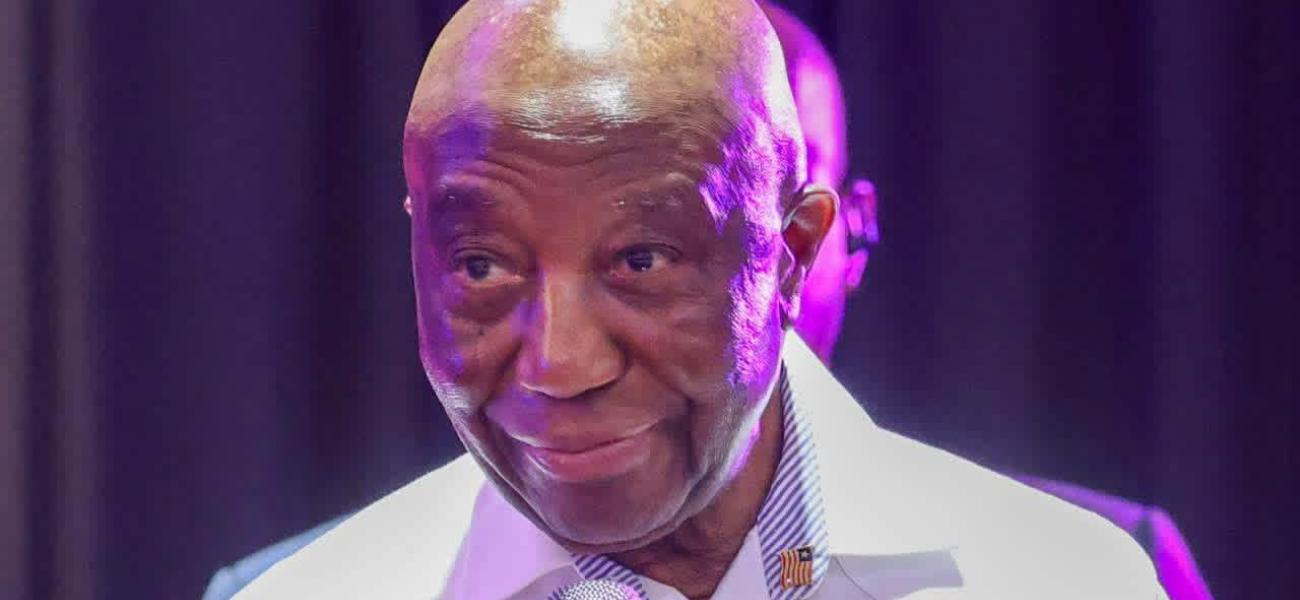
NEW YORK – President Joseph Nyuma Boakai has told the United Nations that global trust in multilateralism is broken, but the solution is not to abandon it — it is to make it better.
Addressing the 81st Session of the UN General Assembly in New York on Wednesday, September 24, 2026, Boakai said the world is facing a crisis of legitimacy that requires urgent action.
Speaking under the theme “Restoring Trust, Managing Transformation: A United Nations that Delivers for All,” the Liberian leader said the principles of the UN Charter remain relevant, but they have been applied inconsistently.
“Trust in multilateralism is broken and needs to be restored, not because the principles of the Charter are no longer relevant, but because we have applied them inconsistently and selectively,” Boakai said.
“Our answer to that fragmentation cannot be less multilateralism. It must be better multilateralism!”
Liberia's History at the UN
Boakai opened his address by congratulating Khalilur Rahman on his election as President of the 81st UNGA Session and thanked former President Annalena Baerbock for her leadership. He also praised Secretary-General Antonio Guterres as he prepares to end his tenure.
He reminded the Assembly that Liberia was one of only four African countries that signed the UN Charter in San Francisco 80 years ago.
“Having risen from the ashes of conflict to become a resilient democracy, Liberia is living proof that dialogue can overcome division and that institutions can be rebuilt,” he said.
Boakai said his government is focused on accountability, prudent financial management, fighting corruption, and restoring public confidence in the judiciary.
The President said peace and development cannot be separated.
“Without peace, development is impossible, and without inclusive development, peace is an illusion,” he noted.
He called for an end to wars around the world, unhindered humanitarian access, and respect for international humanitarian law, stressing that preventive diplomacy is cheaper than rebuilding after war.
As a current member of the UN Security Council, Boakai said Liberia is confronting new threats in West Africa, including transnational organized crime, cyber warfare, and drug trafficking in the Gulf of Guinea.
“Through our Joint Security forces, we are tightening the vise on transnational drug cartels,” Boakai said. He appealed for international support for coast guard surveillance, intelligence sharing, and modern port security technology.
On development, Boakai warned that developing nations are being squeezed by unsustainable debt and shrinking fiscal space as the 2030 deadline for the Sustainable Development Goals approaches.
He called for urgent reform of the global financial system, demanding more concessional financing, debt relief, and greater voting power for developing countries in the World Bank and IMF.
“A financial system that decides the fate of billions cannot continue to be governed by so few,” he said.
At home, Boakai pointed to progress under his ARREST Agenda for Inclusive Development, which focuses on Agriculture, Roads, Rule of Law, Education, Sanitation, and Tourism, citing improvements in revenue collection and rural roads.
On climate change, he said Liberia contributes almost nothing to global emissions but suffers from coastal erosion, flooding, and poor harvests. At the same time, Liberia protects 42 percent of the Upper Guinean Rainforest, a major global carbon sink.
“Climate responsibility must be paired with climate justice,” he said, urging rich nations to honor climate financing pledges and fully operationalize the loss-and-damage fund.
Boakai said Africa’s youth — over 60 percent of the continent’s population — is its greatest asset and must be equipped with STEM education and digital skills to become creators in the global digital economy.
He reaffirmed Liberia’s commitment to gender equality, saying when women lead, peace lasts longer and economies grow faster.
On technology, he welcomed the UN’s Independent International Scientific Panel on Artificial Intelligence and called for binding ethical rules, especially on the use of AI in warfare.
“Innovation must protect human development, not automate human destruction,” Boakai said.
Boakai reserved his strongest message for reform of the UN Security Council, describing Africa’s exclusion as a historic injustice.
“Eighty years of patience is enough. The time for structural reform is now,” he declared.
He noted that Africa has 1.5 billion people and makes up nearly one-third of UN members, yet 80 percent of Security Council decisions are about Africa — with no permanent African seat.
Liberia, he said, fully supports the Common African Position, which demands at least two permanent seats for Africa with all rights, including the veto as long as it exists, plus more non-permanent seats.
“Correcting this imbalance is not a favor to Africa; it is necessary to restore the United Nations' trust, credibility, and legitimacy,” he said.
Boakai closed by saying Liberia’s journey from civil war to democracy proves that trust can be restored, and called on the UN to move beyond debating crises to solving them.