Turning International Connections into National Development Opportunities
In a country where fire outbreaks can destroy homes, businesses, public infrastructure, and livelihoods within minutes, the importance of a modern, professional, and adequately equipped national fire service cannot be overstated.
For Liberia, strengthening emergency response capabilities is not simply a matter of purchasing firefighting trucks or constructing additional fire stations. It is a national development imperative that requires sustained investment, professional training, institutional reform, technological advancement, and strategic international cooperation.
At the intersection of these priorities stands the Liberia–Canada Investment Office, headed by Hon. Jallahqueenaa Hawa Konneh, whose investment facilitation and international partnership efforts are helping to connect Liberia's institutional development needs with opportunities for technical cooperation and private-sector participation.
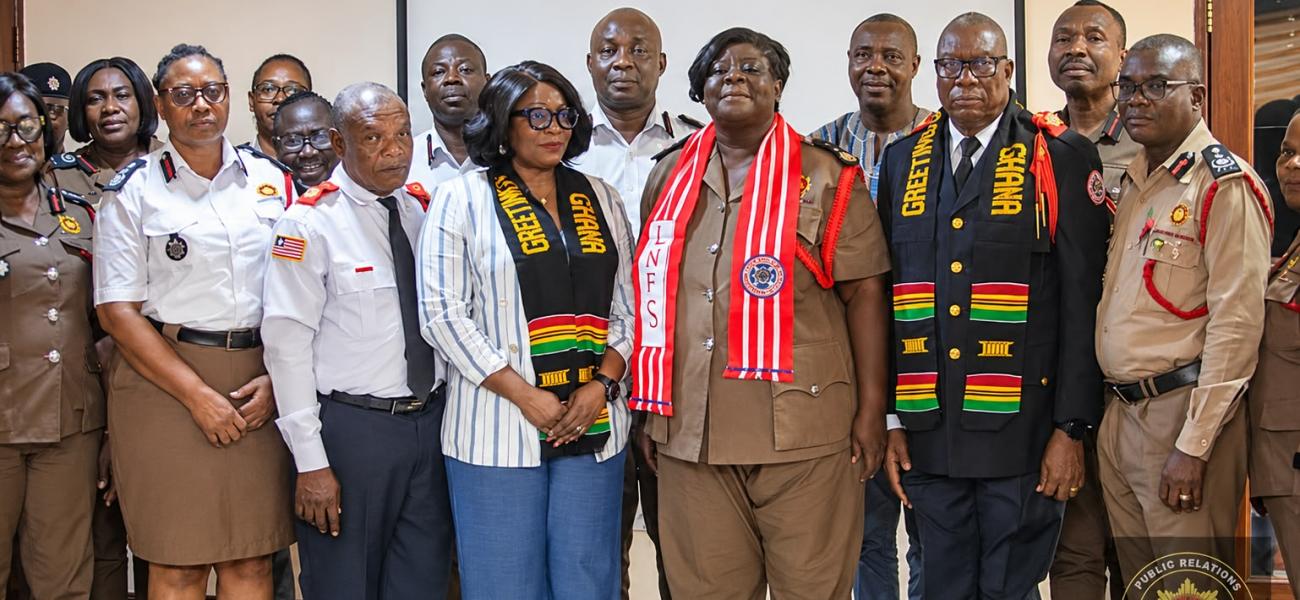
The Office's involvement in facilitating a high-level engagement involving the Liberia National Fire Service (LNFS), the Ghana National Fire Service (GNFS), and Premium Pole Investments illustrates an expanding dimension of investment diplomacy: mobilizing international relationships not only to attract commercial investment but also to strengthen essential public institutions.
The engagement, undertaken during the November 4–6, 2026 period, involved Liberia's Chief Fire Officer, Hon. G. Warsuwah Barvoul, and focused on advancing cooperation to support implementation of the Liberia National Fire Service's Five-Year Strategic Plan (2025–2030).
While the Ghana visit represents an important diplomatic and institutional engagement, its greater significance lies in the possibility of transforming international partnerships into practical improvements in fire prevention, emergency preparedness, firefighter training, and public safety across Liberia.
Jallahqueena Hawa Konneh: Expanding the Frontiers of Investment Diplomacy
For Hon. Jallahqueenaa Hawa Konneh, the initiative demonstrates the potential of investment facilitation to contribute directly to national development priorities.
Traditionally, investment promotion offices are associated with attracting foreign capital into sectors such as agriculture, manufacturing, energy, infrastructure, and trade. However, Liberia's development challenges require a broader approach—one that recognizes the relationship between institutional capacity, public safety, economic stability, and investor confidence.
Under Hon. Konneh's leadership, the Liberia–Canada Investment Office is positioning itself as a bridge between Liberia's development institutions and prospective international partners capable of contributing technical expertise, investment resources, and institutional support.
Its facilitating role in the Ghana engagement highlights three important dimensions of this approach.
First, the Office is helping connect Liberia's public institutions with international cooperation opportunities that correspond to identified national priorities.
Second, it is supporting engagement between public-sector authorities and prospective private-sector partners, creating opportunities to explore investment and technical assistance arrangements.
Third, it is demonstrating that effective investment diplomacy must consider the wider conditions necessary for sustainable economic development, including safety, institutional resilience, and the protection of national assets.
This approach is particularly relevant to Liberia, where public institutions continue to require investment in infrastructure, equipment, specialized training, and modern operational systems.
The significance of Hon. Konneh's contribution lies not merely in facilitating meetings, but in helping create pathways through which international relationships could produce measurable development outcomes.
Nevertheless, the ultimate measure of success will depend on the agreements, resources, and institutional improvements that emerge from these engagements.
The Ghana Engagement: Building a Framework for Fire Service Modernization
The working visit by Liberia's Chief Fire Officer, Hon. G. Warsuwah Barvoul, to Ghana provided an opportunity to explore practical cooperation with the Ghana National Fire Service and prospective investment partners.
Ghana's fire service offers a relevant regional counterpart for professional exchanges, operational learning, and institutional cooperation.
The discussions centered on areas essential to the modernization of Liberia's emergency response capabilities, including advanced firefighter training, specialized technical development, fire prevention strategies, equipment modernization, institutional reforms, and improved operational coordination.
The engagement also explored opportunities for technical assistance and public–private partnerships to support the LNFS Five-Year Strategic Plan covering 2025–2030.
For Liberia, such cooperation could provide a framework for addressing longstanding challenges affecting the fire service, including access to modern equipment, specialized training, logistical support, and emergency response infrastructure.
Importantly, regional cooperation offers opportunities to learn from the experiences of other African institutions while adapting relevant practices to Liberia's specific operational and financial circumstances.
The involvement of the Liberia–Canada Investment Office adds an investment facilitation dimension to these discussions, potentially connecting regional technical expertise with international financing and private-sector participation.
Premium Pole Investments and the Promise of Public–Private Cooperation
An important component of the engagement is the proposed involvement of Premium Pole Investments, which is developing a technical assistance programme under a public–private partnership framework to support implementation of the LNFS strategic plan.
The proposed arrangement could create opportunities to combine government leadership with private-sector resources and technical expertise.
If successfully negotiated and implemented, such cooperation could contribute to the acquisition of modern firefighting equipment, improvements in operational systems, professional development, and institutional strengthening.
However, the proposed partnership remains subject to further engagement and agreement.
Additional discussions expected to take place in Liberia will be important in defining the proposed programme's scope, financing arrangements, institutional responsibilities, implementation timelines, and accountability mechanisms.
For the Liberia–Canada Investment Office, this next phase presents an opportunity to continue supporting constructive dialogue among the participating institutions while encouraging partnership arrangements that are financially responsible, transparent, and aligned with Liberia's development priorities.
The sustainability of any future arrangement will be particularly important. Modern firefighting equipment requires ongoing maintenance, reliable spare parts, adequate fuel supplies, trained operators, and consistent budgetary support.
Consequently, successful modernization must extend beyond initial procurement to include long-term institutional capacity and operational sustainability.
Why Fire Service Modernization Is Also an Economic Investment
One of the most important lessons emerging from this initiative is that public safety and economic development are closely interconnected.
A fire outbreak in a major commercial center can destroy businesses, eliminate employment opportunities, interrupt essential services, and impose substantial financial losses on families and investors.
Similarly, inadequate emergency response capacity can increase the vulnerability of factories, warehouses, hotels, hospitals, educational institutions, markets, and critical national infrastructure.
For a country seeking to attract investment, expand industrial activity, and stimulate private-sector growth, effective fire prevention and emergency response capabilities are essential.
A stronger Liberia National Fire Service could help create an environment in which businesses and communities operate with greater confidence.
It could also support improved compliance with fire safety standards, encourage responsible commercial development, and strengthen protection for infrastructure investments.
This is where the investment facilitation role of Hon. Konneh and the Liberia–Canada Investment Office becomes especially significant.
By supporting partnerships aimed at improving public safety, the Office is helping draw attention to an often-overlooked foundation of investment competitiveness: the capacity of national institutions to protect people, property, and economic activity.
Investment promotion, therefore, should not be measured solely by the volume of capital attracted into a country. It should also consider whether partnerships help establish the conditions necessary for investment to succeed and remain sustainable.
Aligning International Partnerships with Liberia's National Development Agenda
The initiative also carries relevance for the Government of Liberia's ARREST Agenda for Inclusive Development, particularly its broader emphasis on institutional effectiveness, infrastructure development, economic transformation, and improved public services.
Modernizing the Liberia National Fire Service could contribute to these objectives by strengthening the country's ability to prevent and respond to emergencies that threaten human lives and economic assets.
The proposed cooperation could also support Liberia's efforts to develop more resilient public institutions capable of meeting changing national demands.
As urban communities expand and commercial activities increase, emergency response systems must evolve accordingly.
Modern buildings, industrial facilities, petroleum installations, transportation hubs, and expanding commercial centers require specialized fire prevention standards and effective response capabilities.
A well-equipped fire service is therefore a critical component of national preparedness and responsible infrastructure development.
By facilitating discussions around these priorities, the Liberia–Canada Investment Office is demonstrating how international partnerships can be aligned with specific institutional needs rather than pursued as isolated diplomatic engagements.
A Broader Vision for Liberia–Canada Investment Engagement
Although the working visit took place in Ghana, the involvement of the Liberia–Canada Investment Office illustrates the potential for investment promotion platforms to operate across geographic and institutional boundaries.
The Office's role demonstrates that international engagement need not be confined to bilateral commercial transactions between Liberia and Canada.
Instead, an investment facilitation platform can help connect Liberian institutions with relevant partners in other countries when those relationships offer opportunities to advance national priorities.
This model of cooperation is particularly valuable for developing economies, where technical expertise, investment capital, and institutional experience may be distributed across several international partners.
The Ghana engagement provides an example of how regional cooperation, private-sector participation, and investment facilitation can potentially reinforce one another.
For Hon. Konneh, the initiative represents an opportunity to strengthen the Liberia–Canada Investment Office's contribution to national development by demonstrating its relevance beyond conventional investment promotion.
It also creates an opportunity to build a wider portfolio of institutional partnerships in areas where Liberia requires sustained technical and financial support.
Such an approach could, over time, strengthen the Office's position as a development-oriented investment facilitation institution, provided its engagements are supported by concrete results.
From Diplomatic Engagement to Tangible Results: The Road Ahead
While the Ghana engagement represents an encouraging step, the most consequential phase of the initiative lies ahead.
For the proposed cooperation to deliver meaningful results, stakeholders will need to move from preliminary discussions toward clearly defined commitments and implementation arrangements.
Priority considerations should include the development of a comprehensive technical assistance framework, identification of funding sources, professional training opportunities, equipment and infrastructure requirements, and realistic implementation schedules.
Equally important will be the establishment of monitoring and evaluation mechanisms to determine whether the partnership is producing measurable improvements in Liberia's firefighting capabilities.
Potential indicators could include the number of firefighters receiving specialized training, improvements in equipment availability, expanded emergency response coverage, enhanced fire prevention programmes, and stronger institutional operating procedures.
The Liberia–Canada Investment Office could continue playing a constructive facilitation role by supporting communication among stakeholders, encouraging investment dialogue, and helping maintain momentum toward practical agreements.
The objective should be clear: ensuring that international cooperation translates into improvements that ordinary Liberians can experience through safer communities, better emergency response, and stronger protection of lives and property.
A Significant Opportunity for Leadership and National Impact
The involvement of Hon. Jallahqueenaa Hawa Konneh in facilitating the Ghana engagement brings attention to the importance of proactive leadership in identifying and connecting opportunities for national development.
In Liberia's development landscape, the ability to establish relationships is valuable. The ability to translate those relationships into sustainable institutional improvements is even more consequential.
Through the Liberia–Canada Investment Office, Hon. Konneh is contributing to an approach that recognizes international investment facilitation as a potential instrument for institutional transformation and public-sector development.
Her role in supporting engagement among the Liberia National Fire Service, the Ghana National Fire Service, and Premium Pole Investments illustrates the importance of building partnerships around practical national needs.
For Liberia, the potential benefits extend far beyond the fire service itself.
A stronger emergency response institution could help protect businesses, reduce preventable losses, improve community resilience, and support a more secure environment for economic activity.
The initiative also provides an important reminder that meaningful national development often begins with the willingness to connect institutions, expertise, and resources around a shared objective.
Investing in Safety Is Investing in Liberia's Future
The Liberia–Canada Investment Office's involvement in advancing cooperation for the modernization of the Liberia National Fire Service represents a noteworthy example of how investment facilitation can support national institutional priorities.
Under the leadership of Hon. Jallahqueenaa Hawa Konneh, the Office has helped facilitate an engagement that brings together regional institutional cooperation, prospective private-sector participation, and Liberia's long-term emergency response development objectives.
The Ghana working visit should be viewed as an important step in a broader process rather than a completed transformation.
Its lasting significance will depend on whether the participating institutions can convert their discussions into sustainable agreements, effective technical support, and measurable improvements in Liberia's fire prevention and emergency response systems.
For HardFacts Envisioning Liberia Magazine, the larger development lesson is compelling: investment diplomacy becomes especially valuable when it connects international opportunities with the everyday needs of citizens.
Hon. Jallahqueenaa Hawa Konneh's facilitating role offers an example of how strategic international engagement can help open doors for institutional development, while underscoring the responsibility to turn promising partnerships into practical results.
Ultimately, the modernization of Liberia's fire service is about much more than equipment, infrastructure, or international agreements.
It is about protecting families, preserving livelihoods, safeguarding national investments, and building a Liberia better prepared to respond to emergencies.
Because a nation that invests in protecting its people is also investing in the security, resilience, and prosperity of its future.
HardFacts Envisioning Liberia Magazine — Promoting Development, Accountability, Institutional Transformation, and a Greater Liberia.