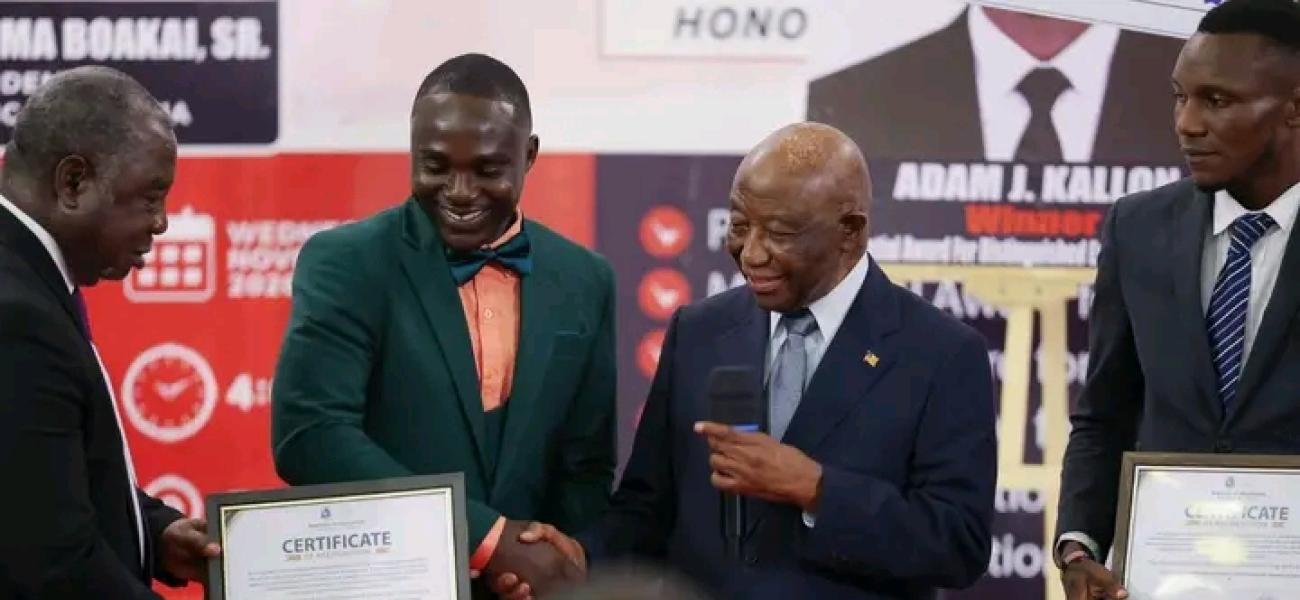
EJ Ministerial Complex, Monrovia-Liberia, November 19, 2026 – Newly honored as Liberia’s 2026/2027 National Best Teacher, Bong County Chemistry educator Adam Jarto Kallon has pledged to broaden access to practical science education, digital literacy, and youth empowerment programs nationwide after receiving the prestigious Presidential Award for Distinguished Excellence in Teaching. Emerging at the top of a rigorous national selection process, Kallon plans to leverage his new national platform to bridge the gap between theoretical classroom instruction and applied technical skills for Liberian students, particularly those studying in under-resourced rural communities.
Teaching Chemistry in Gbarnga, the administrative hub of Bong County, Kallon earned the top national distinction under the Ministry of Education’s Liberia National Educators’ Excellence Awards Programme (LNEEAP) 2026. Designed to spotlight classroom innovation, reward pedagogical excellence, and restore pride to the teaching profession, the annual awards recognize educators whose dedication produces lasting academic and social impact. For Kallon, the accolade affirms years of creative teaching, resourcefulness, and community-driven mentorship across central Liberia.
Delivering his acceptance speech after receiving the honor, Kallon framed the award not as an individual triumph, but as a tribute to the perseverance, daily sacrifices, and unwavering commitment of thousands of Liberian teachers laboring in difficult environments. He promised to use the visibility and institutional reach of his office to champion instructional reforms, mentor fellow classroom teachers, and expand outreach programs that directly strengthen Liberia’s education sector.
Drawing inspiration from his own background, Kallon—a native of Kandakai Town in Yellequelleh District, Bong County—noted that his rise from a rural community to the nation’s highest teaching honor sends an empowering signal to students and educators alike. He emphasized that his journey proves a person’s geographic origin or humble beginnings should never restrict their ambition, intellectual growth, or capacity to make meaningful contributions to national progress.
During his remarks, Kallon expressed sincere appreciation to President Joseph Nyuma Boakai, Minister of Education Dr. Jarso Maley Jallah, and the leadership of the Ministry of Education for instituting a merit-based framework that honors frontline educators. By celebrating teaching excellence alongside national development priorities, he observed, the administration is reinforcing the foundational role of quality instruction in building Liberia’s human capital.
Kallon also paid tribute to the school communities, colleagues, and loved ones who supported his growth as an educator, specifically recognizing the leadership, faculty, and students of Paul A. Rader High School and LAG Foundation High School, where his student-centered approach took root. He further thanked his family members, mentors, and fellow teachers for standing beside him throughout his career, noting that meaningful educational impact relies on strong collaborative support.
Looking beyond routine textbook lessons, Kallon stressed that his vision for teaching centers on equipping young people with practical competencies to overcome everyday socio-economic challenges. Rather than viewing education strictly through the lens of passing national examinations, he has consistently advocated for hands-on learning experiences that connect academic theory to real-world problem-solving, innovation, and community self-reliance.
Among his signature achievements was organizing what he described as Liberia’s first-ever student-led Chemistry Symposium on May 16, 2026. The pioneering academic gathering brought together six educational stakeholders, 25 high school Chemistry teachers, and over 750 students, creating an interactive space for student-driven scientific demonstrations, peer learning, and academic exchange rarely accessible to secondary students outside Monrovia.
According to Kallon, the symposium was conceived to prove that limited laboratory infrastructure and shortages of expensive synthetic chemicals need not prevent schools from delivering authentic experimental science. By utilizing locally available materials and creative improvisation, the event demonstrated how teachers and students can safely conduct meaningful chemistry experiments, removing a major obstacle to science instruction in rural schools.
Alongside his work in science education, Kallon has actively worked to close the digital skills gap facing Liberian youth in an increasingly technology-driven world. Between July and August 2026, he organized and delivered a free two-month digital literacy and Information and Communications Technology (ICT) training program that trained 320 young people, awarding participants certificates in computer literacy and foundational computer operations to boost their academic and employment prospects.
In September 2026, focusing on strengthening teacher capacity, Kallon designed and led a three-day, hands-on professional development workshop for 100 science teachers across Bong County, sharing practical methods for teaching science with low-cost, locally sourced tools. He also pointed to a youth agriculture project launched in October 2025, which engaged 35 young people in practical farming and agribusiness activities, illustrating how applied science can promote food security and youth entrepreneurship.
Explaining the motivation behind these varied initiatives, Kallon emphasized that every project stems from his conviction that education must go beyond exam preparation to nurture creativity, critical thinking, and practical skills capable of solving real-life problems in local communities.
With his new mandate as Liberia’s Best Teacher, Kallon vowed to scale up and sustain these science, digital literacy, and youth agriculture programs across Bong County and into other regions of Liberia. He pledged to align his outreach with the Ministry of Education’s broader policies and reforms while encouraging stronger participation and collaboration from parents, local authorities, and community organizations.
Sharing his wider vision for the country’s schools, Kallon stated that every school in Liberia, regardless of location or budget constraints, should provide students with opportunities to learn science through hands-on, practical engagement. He called for heightened investment in Science, Technology, Engineering, and Mathematics (STEM) education and outlined an ambitious goal of helping at least 85 percent of Liberia’s young people acquire essential digital literacy and ICT skills.
Viewing his presidential honor as a call to deeper service rather than a resting point, Kallon urged fellow teachers nationwide to recognize their vital responsibility in shaping young minds, instilling strong values, and preparing the next generation of Liberian leaders.
He concluded by noting that realizing these goals will demand strong partnerships and sustained collective effort, reaffirming his dedication to transforming education into a decisive catalyst for Liberia’s national development.